
Let’s start with some of the most common terms, like co-pay,
Your health insurance options depend on your employment status, household size, and income. The four main types of insurance are employer-based plans, plans on the Marketplace (also known as the Health Insurance Exchange), private plans (also known as off-exchange plans), and public insurance such as Medicare and Medicaid. You can usually choose or change your plan once a year during open enrollment. Coverage starts after open enrollment and usually lasts a full year. Outside of open enrollment, you can make changes if you experience a qualifying life event such as getting married, having a baby, or losing your current health insurance.
Employer-Based (Group) Plans
Most Americans have health insurance coverage through their own or a family member's employer. These employer-based or group plans are chosen by an employer and offered to eligible employees and their dependents. Any businesses with 50 or more full-time employees is required to provide health insurance to their employees. Your employer will typically share the cost of your
There are two types of employer-based coverage:
Fully funded group plans : The employer buys coverage from an insurance company and the insurance company processes and pays health care provider claims. Appeals are made directly to the insurance company.- Self-funded group plans: The employer itself may process and pay health care provider claims. However, in some cases, there may be a third-party administrator that assists with health insurance claims. It is often up to the employer to decide whether to cover a service. In most cases, appeals are made directly to the employer's plan administrator.
COBRA
The Consolidated Omnibus Budget Reconciliation Act (COBRA) is a form of employer-based coverage that gives employees and their families the option to extend their insurance if they lose job-based health coverage by leaving their job or getting laid off. An employer is required to offer COBRA if it has 20 or more employees on more than 50 percent of its typical business days. Because the employer no longer helps pay the monthly premium, you are responsible for paying the full cost of the plan, which can be expensive. However, it may still be a good option for those who only need coverage for a short time and have already met their
COBRA coverage can continue for up to 18 months. Once you opt into COBRA, you cannot drop it and switch to a Marketplace plan until the following year or until the open enrollment period. This is because a voluntary loss of coverage is not considered to be a qualifying life event for the
Those who do not choose to take COBRA coverage can enroll in a Marketplace plan instead but will typically need to decide within 60 days of the loss of job-based coverage. The choice between COBRA and a Marketplace plan largely depends on your individual circumstances. If you're not sure how to find the best plan for you, a Compass case manager can provide free, one-on-one assistance.
Health Insurance Marketplace Plans
The Health Insurance Marketplace, also known as the Health Insurance Exchange, provides people a way to buy a plan if they do not have access to group-based employer plans or do not qualify for Medicare or Medicaid. To access your state's Marketplace, visit healthcare.gov.
Typically, Marketplace insurance plans are grouped by levels of coverage named after different types of metals:
- Bronze plans offer the least coverage but also have the least expensive monthly premiums. On average, you will pay 40 percent of your health care costs with a bronze plan.
- Silver plans will usually require you to pay 30 percent of your health care costs.
- Gold plans typically require you to pay 20 percent of your health care costs.
- Platinum plans offer the most coverage but also have the most expensive monthly premiums. On average, you will pay 10 percent of your health care costs with platinum plans.
You can only buy a new plan or make changes to an existing Marketplace plan during the annual open enrollment period unless you have a life event that qualifies you for a special enrollment period.
Marketplace Subsidies
Based on your household size or income, you may be eligible for cost savings in the form of a tax credit to lower your monthly premiums. You can qualify for a premium tax credit if your household income range is between 100 percent and 400 percent of the Federal Poverty Level (FPL). For more information on eligibility, visit the Saving Money on Health Insurance section on healthcare.gov.
Marketplace plans also offer access to cost-sharing reduction plans. These are specially designed Silver-level plans with lower co-pays and deductibles. These plans are only available to people with incomes between 100 percent and 250 percent of the FPL. Individuals who fall within this category can take advantage of the premium subsidy at the same time, significantly lowering cost for health coverage.
Private Insurance Plan
Private or off-exchange insurance is provided by private insurance companies. Individuals can purchase these plans through a broker or directly from an insurance company outside the marketplace. These plans vary greatly in what services are covered, premiums, and other
Public Insurance Programs
Public health insurance programs are government-funded and provide health care assistance to qualifying individuals and their families. These programs include:
- Medicare
- Medicaid
- Children's Health Insurance Program (CHIP)
- U.S. Department of Veterans Affairs
- Department of Defense TRICARE and TRICARE for Life programs
- Indian Health Service (IHS)
States also have programs such as programs for children with special health care needs (sometimes called CSHCN programs). In most states, families that do not qualify for Medicaid may be eligible for this program, although some states require enrollment in Medicaid to qualify. Some states may also offer this program to adults who have a qualifying diagnosis.
Primary Versus Secondary Insurance
Some people with cystic fibrosis have more than one form of health insurance coverage. In these cases, you will have both a primary and a secondary insurance provider and your benefits must be coordinated to ensure you receive maximum coverage.
Your primary health insurance plan is the first to pay for services or treatments you receive. If the primary plan does not cover a service or treatment completely or at all, then your secondary health plan or program may cover it. It is important to notify both plans, so that coordination of benefits can be set up correctly. If a
Learning more about the structure of plan types can help you make the most of your coverage and evaluate your options.
A provider network is a set of doctors, hospitals, clinics, and other health care providers that work with your insurance plan to provide care. Using an
For people with CF, it's important to know if your care center, doctors, and pharmacies are in a plan's network when choosing insurance. You can check this by calling your care center to confirm they accept the plan and by checking the plan's network for your doctors and hospitals, either online or by phone. Not all providers are in a plan's network, so make sure you understand what is in-network and what would happen if you received care out-of-network.
Health Maintenance Organization
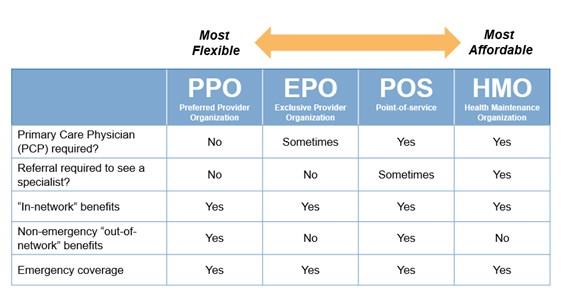
A health maintenance organization (HMO) plan has strict limits on coverage. The plan covers care only from providers in the network — often called "Preferred Providers" — and does not pay for care from the providers outside of the HMO network, except in an emergency. HMOs require you to choose a primary care physician (PCP) who must then give you a referral to see any specialist. Without a referral, HMO plans do not cover care from a specialist and you will be responsible for most, if not all, of the associated costs. It is also possible that a specialist will not see you without a referral.
The primary benefit of HMOs is that they may have lower premiums and may have low or no
Although HMO plans may feature lower health insurance costs up front, they can be more restrictive in covered services and how they are accessed. When you are considering an HMO, it’s important to make sure your CF care is covered.
Preferred Provider Organization
A preferred provider organization (PPO) plan also has a network of health care providers, but you have more flexibility to choose providers outside the plan's network at a higher cost. Additionally, you do not need a referral to see a specialist. However, you may pay more in premiums for this flexibility.
Exclusive Provider Organization
Exclusive provider organization (EPO) plans combine the flexibility of a PPO plan with the cost-saving benefits of an HMO plan by giving you the freedom to choose any provider within an EPO network without selecting a primary care provider (PCP). In addition, EPO plans do not require referrals from a PCP to see a specialist.
It is important to note that EPOs do not cover the services obtained from providers outside of the plan’s network. When selecting this plan, it is important for you to confirm that your CF providers are in-network before enrolling. If you do go to a doctor or hospital that does not accept your plan, you will be responsible for paying all care-associated costs.
Point of Service Plan
A point-of-service (POS) plan combines different elements of HMO and PPO plans. Like an HMO plan, you must choose a PCP, but you can also go outside of the provider network for health care services with greater out-of-pocket costs, like a PPO plan. Services provided by the PCP are typically not subject to a deductible, and a wide range of preventive care benefits are also included.
The primary benefit of a POS plan is that it offers a “middle of the road” option in which you have more choices than what an HMO plan typically offers while you pay less than with a PPO plan.
High-Deductible Health Plans
As the name implies, a high-deductible health plan has a higher deductible than other plan options. They are often paired with a tax-exempt health savings account (HSA). It’s a personal bank account to help you save and pay for covered health care services and qualified medical expenses. The IRS sets a limit on how much you can put into it each year. For more information, visit the Health Savings Accounts section on irs.gov.
Other Types of Savings Accounts
You may also be eligible for a flexible spending account (FSA) or a health
Almost every insurance plan has a set of defined pharmacy and medical benefits. Understanding how your plan's pharmacy and medical benefits will be handled by your health insurance provider is an important aspect of choosing the right plan.
Understanding Medical Benefits
A plan's medical benefits cover things like visits to your care center, hospital stays, at-home IV treatments, medical devices, therapies, breathing treatments, procedures, and lab tests.
These services fall under your plan's medical
Understanding Pharmacy Benefits
A plan's pharmacy benefits determine the level of coverage for prescription medications. Most health insurance plans have a tiered structure for pharmacy benefits, offering different co-pay or coinsurance amounts that increase in price as you move through each tier. Most plans have three to five tiers for prescription medications. For example:
- Tier 1: Generic medications (least expensive)
- Tier 2: Preferred brand-name medications
- Tier 3: Non-preferred brand-name medications
- Tier 4: Specialty medications (most expensive)
Because each tier has different associated costs, it is important to know which tier your medication is in before selecting a plan.
Beyond pharmacy tiers, some insurance plans have programs that can impact the total amount you pay for your drugs. These include co-pay accumulators, maximizers, and alternative funding programs.
Specialty Pharmacies
A
- High-cost drugs
- Services such as refill reminders, overnight deliveries, and online prescription tracking
- Therapy management to ensure
safety and compliance
Medications from specialty pharmacies typically need to be handled and stored in a particular way to maintain effectiveness. Your insurance plan may require you to use a certain specialty pharmacy.
Insurance is complicated. To learn more about your insurance options and coverage:
- Contact CF Foundation Compass at 844-COMPASS (844-266-7277).
- Learn about how to understand and choose coverage with Navigating CF
Share this article
Topics
Insurance
|
Managing Finances