The health care professionals that make up your CF care team are experts in CF care. But you are the expert on the daily challenges of living with your CF. That means you play an essential role with your care team in creating a personalized treatment plan that is realistic and consistent with your lifestyle.
Your treatment plan should be based on your medical test results, changes in your health, new available therapies, and your personal goals.
By communicating regularly with your care team, you can make sure that your treatment plan continues to address the evolving challenges of living with CF. It's important to let your care team know about changes or challenges in your life so that your treatment plan can be adjusted to meet your needs.
These changes may include attending college or starting a new job, upcoming travel, a new relationship, or other significant events in your life. Potential challenges could be the physical and emotional challenges that come with aging or pressure from friends or family to participate in activities that you do not feel up to or which may put you at risk of exposure to people who are sick.
Discussions with your care team can happen during a clinic visit or in the hospital, and you can always reach out by calling your care center between visits.
Meet Your CF Care Team
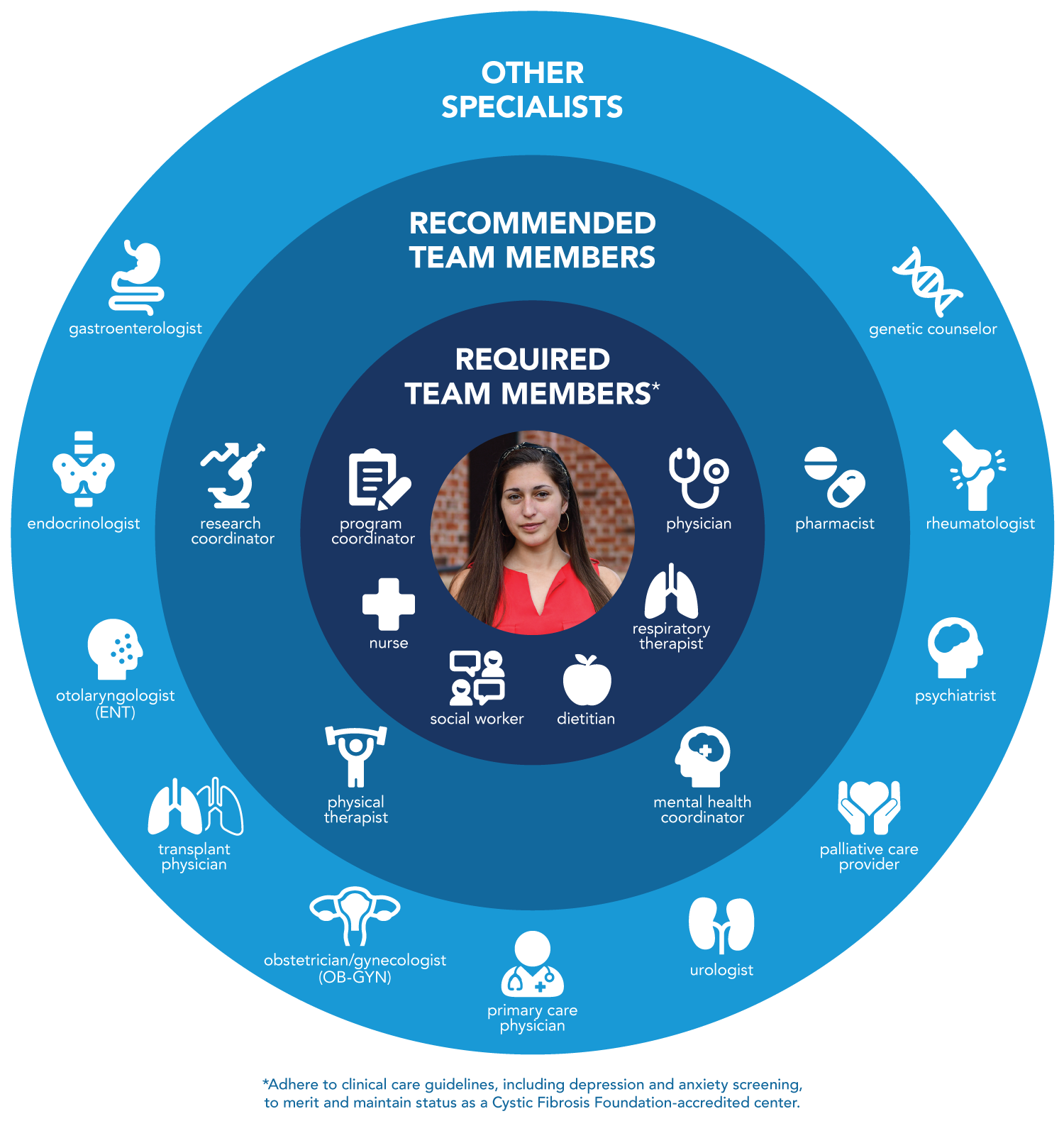
The CF care team approach means that health care professionals work together in partnership with you to provide comprehensive and high quality care for you or your child.
Ready to meet your team? Let's start with the most important member.
The Person Living with CF
You are an important member of your or your child's CF care team. While you depend on your CF care team for essential guidance on your medical care, you are the expert in the daily management of your CF.
There is a lot that you and your CF care team can do together to help you maintain your health with CF. As an active member on your own care team, you can help make sure that your treatment plan and comprehensive CF care reflects your personal needs and goals so that you can live a longer and healthier life.
Click on this image to save it to your device. You can use it to start a discussion about your care needs with your care team.
Your CF Nurse
CF nurses specialize in CF care and fill a variety of nursing roles in the CF care center setting. At many CF care centers, your CF nurse may also be the program or care center coordinator. The coordinator works with all members on the CF care team to ensure that the CF program runs smoothly, which can include participating in quality improvement (QI) initiatives and making sure that best practice care guidelines are properly implemented at your CF care center.
Your CF nurse is your primary contact and is there to address your concerns, answer questions or direct you to the right CF care team member when discussing a specific part of your treatment plan. CF nurses also have the primary responsibility of providing CF education at initial diagnosis and throughout life.
If you're not sure who the correct person is to discuss a concern or answer a particular question, start with your CF nurse.
At a glance, your CF nurse:
Helps coordinate and carry out medical care plans.
Walks you through your daily treatment plan and any changes.
Helps facilitate communication between you and the other members on your CF care team.
Alerts your CF care team about psychological, social and financial concerns you or your family may be experiencing.
Provides you with health information or directs you to resources to help you manage your disease.
Helps you educate family members, friends, the public and other health care professionals like your primary care doctor or other non-CF specialists on ways to support your health with CF.
The nurses at your care center may include a nurse practitioner (NP) and or a clinical nurse specialist (CNS). Your team may also include a physician assistant (PA), who like an NP, has additional education and training in order to perform physical examinations and prescribe medications and treatments.
Your CF Doctor
The medical doctor at your care center is an expert in CF care and is often the director for the CF program. He or she is likely trained as a pulmonologist to diagnose and treat lung diseases and will work with you, your family and the other members of your care team to develop an individualized CF medical plan. This means the plan is based on your medical test results, changes to your health status, new available therapies and your personal goals.
CF is a complex disease that affects many parts of the body differently as you age into adulthood. In order to provide you with comprehensive care based on current medical best practices, your CF doctor is responsible for staying on top of the latest CF care guidelines, trends in patient outcomes and new medications and therapies. He or she also collaborates with other health care professionals, including your primary care doctor, when assessing the details and outcomes of your care so that your overall health is at its best.
Many CF doctors also participate in quality improvement (QI) initiatives to learn about ways to improve your care or teach other health care professionals and the public on ways to deliver quality care for people with CF. Some doctors may also conduct research through clinical trials to help bring about new CF treatments and therapies.
At a glance, your CF doctor:
Works with you and other care team members to develop a medical plan that meets your individual needs.
Applies clinical best practices by staying on top of CF care guidelines along with new medications and therapies.
Assesses the details of your care to inform changes to your care plan in consultation with you, other health care professionals, and your primary care doctor.
Participates in QI initiatives and educates others on CF care.
Conducts clinical trials to bring about new CF treatments and therapies for CF.
Your CF Dietitian
We know that higher body weight promotes better lung function and that good nutrition is essential for building and maintaining a healthy body weight. Registered dietitians are trained to assess your daily food intake, growth and your overall nutritional status. They help you work towards your optimal body weight so that you have the calories and nutrients needed to fight off lung infections and maintain lung function.
With your personal goals and lifestyle in mind, your CF dietitian can teach you and your family how to adjust your eating habits, recommend dietary supplements and vitamins and adjust your enzyme intake. They may also suggest tube feeding as a healthy option to help you meet your nutritional goals if you can't get what you need from eating and drinking alone.
Your CF dietitian would also help you manage CF-related complications such as CF-related diabetes (CFRD) and bone diseases like osteoporosis.
At a glance, your CF dietitian:
Helps you gain or maintain a healthy weight (also known as a healthy Body Mass Index or BMI).
Develops a nutritional plan that is high in calories, protein, vitamins and minerals.
Recommends fat-soluble vitamins, pancreatic enzymes and additional dietary supplements.
Works with you to meet your nutritional goals through tube feeding.
Helps you manage CFRD and bone diseases like osteoporosis.
Your CF Social Worker
Maintaining your health by taking your medications and doing your therapies can be challenging and affect how you live your life. You may feel overwhelmed trying to keep up with school, work or your relationships, which could have an emotional impact. This is where the social worker on your CF care team can help.
Social workers can provide direct guidance to help you navigate your health insurance coverage, make tough decisions about school or the next steps in your career. They can also refer you to specialists so you can get the help you need.
At a glance, your CF social worker:
Assesses and counsels you on the emotional, social, and financial aspects of living with CF.
Teaches you ways to cope with the stress of your disease and how it impacts family and friends.
Helps you prepare for transitions, such as moving to an adult CF program, going to school and requesting accommodations, or starting a career.
Helps you or your family navigate your health insurance coverage or find financial assistance.
Your social worker may refer you to the Cystic Fibrosis Foundation Compass for additional assistance. Compass is a free, personalized service that can help you with insurance, financial, legal and other issues. Dedicated Compass case managers can assist in coordinating benefits or providing information about benefits offered under your plans. Contact Compass at:
Your CF social worker may refer you to a specialist such as a psychologist. A CF psychologist has expertise in identifying and treating problems with behavior, emotional challenges such as depression or anxiety, learning disabilities and social interactions with family, friends, peers or co-workers.
The CF psychologist on your team may also help you overcome problems with balancing treatments and other aspects of your life by teaching you coping strategies. The sessions you have with a psychologist may be brief consultations during regular CF care center visits or during CF hospitalizations. You may also be referred to other therapists or mental health specialists for ongoing support.
If you decide to see a therapist or mental health specialist, it is important to talk with your health insurance plan. Mental health treatment therapies or seeing a psychiatrist is often covered under a special mental health
"carve-out." This means that your claim for mental health services are processed and paid for by a different company than the company that pays for your medical services.
At a glance, your CF psychologist:
Helps you emotionally adjust to your CF diagnosis or changes in your health.
Helps with behavior management that is related to both general and CF-related issues.
Assesses your cognitive, academic and emotional well-being.
Helps you overcome problems related to your feelings, stress or ability to stick with your CF treatment plan.
Your CF Respiratory Therapist
During your care center visits, the CF respiratory therapist performs pulmonary function tests (PFTs) to measure the air flow and volume in your lungs. This team member also helps you with your pulmonary therapies, which are designed to clear mucus (sputum) out of your lungs, control bacteria and reduce the inflammation of your airways. These therapies involve airway clearance techniques (ACTs) and inhaled or nebulized medications.
Your CF respiratory therapist can teach you and your family how to properly take your inhaled medications. They can also show you how to use and care for the medical equipment used to deliver these medications into your lungs. This equipment may include nebulizers, air compressors and oxygen systems. With their help, you will learn how to clean and maintain this equipment while at home or even when you're travelling.
At a glance, your CF respiratory therapist:
Performs your PFTs during care center visits.
Can teach you and your family how to perform ACTs and how to take your inhaled medications.
Shows you how to use and take care of equipment like nebulizers, air compressors and oxygen systems.
Your CF Physical Therapist
Not all CF care teams include a physical therapist. If yours does, then he or she is trained to design an exercise or physical activity program to fit into your daily routine. Regular exercise helps your overall health because it promotes heart and muscle function, which builds strength and gives you energy to live an active life. It is also important for your health with CF because it can help improve your ability to cough mucus out of your airways, which is critical for better lung function.
Your physical therapist will work with you to design an exercise or fitness program that is based on your age, health status and include sports or other physical activities that you enjoy doing in order to maintain lung function and a generally good physical fitness level.
“My physical therapist challenged me, and when I experienced what oxygen was able to help me accomplish, I immediately began to see it as a tool for my benefit as opposed to something that should define my limitations. A switch was flipped in my mind and that sudden realization — that increasing my oxygen usage could help discover my true physical potential — was a euphoric sensation.” Brian Armstrong, adult with CF, from the CF Community Blog
You can also work with your CF physical therapist on ways to maintain a good posture, build or regain muscle strength, and endurance through various techniques to improve your mobility and lung function. They can also help you address embarrassing issues such as urinary incontinence. In some CF care centers, the physical therapist will also help you learn ACTs, which should be done in addition to your fitness program.
At a glance, your CF physical therapist:
Works with you to design a fitness program for your daily routine.
Can help you find ways to maintain a good posture, build or regain muscle strength and endurance.
May also help you learn ACTs.
Your CF Pharmacist
If your care team includes a CF pharmacist, he or she will help you learn about the benefits and potential side effects of your CF medications, including how to take your medication both at home and while you're in the hospital. They work with you to make sure the medications that you've been prescribed do not react with each other in a way that can harm you. CF pharmacists also check dosages so you get the right amount of medication at the right time in order to be the most effective.
Your CF Research Coordinator
Your team may also have a CF research coordinator, who can answer questions about a clinical trial and help determine if you are eligible to enroll or participate in a specific trial. Clinical trials usually take place at a care center that is also a research site.
Other Physician Specialists
Additional members of your CF care team may include physician specialists. These health care professionals are also referred to as subspecialists and have extensive training and practice in a particular field of medicine or surgery.
Physician specialists who may be involved with CF care include:
Otolaryngologist
An otolaryngologist (or "ENT" for ear, nose and throat doctor) is a doctor who has special training in the diagnosis and treatment of disorders that affect the nose and sinuses. The same basic defect that affects the lining of the lungs can also affect the lining of the nose and sinuses in people with CF.
Gastroenterologist
A gastroenterologist is a doctor who has special training in the diagnosis and treatment of diseases of the digestive system. This includes problems with the esophagus, stomach, intestines and liver.
Endocrinologist
An endocrinologist is a doctor with special training in the diagnosis and treatment of CFRD and other hormonal diseases, including problems with thyroid hormone and growth hormone.
Health Care Professionals in Training
If you are receiving care at a CF Foundation-accredited care center, your care team may include other doctors, medical students and health care professionals who are learning about CF and the best ways to treat people with CF.
Health care professionals who are being trained in CF care include:
Fellows
A fellow is a doctor who has finished medical school and residency and is getting specialty training. The primary or attending CF doctor supervises fellows. At CF care centers, fellows are often pediatricians or internal medicine doctors training to become pulmonologists. After years of special training, the fellow often goes to another CF care center to be a CF doctor.
Residents
A resident is a doctor who, after finishing medical school and receiving a medical degree, is getting advanced training, often in pediatrics or internal medicine.
Medical Students
A medical student is working to become a doctor. Medical students are learning about diagnosing illnesses, caring for people and evaluating and reporting a person's condition and progress to the attending physician.
Genetic Counselors
A genetic counselor is a health care professional trained in genetics. A discussion with a genetic counselor can help you understand inherited conditions and how an inherited disease is passed on from parent(s) to children. For example, families with a history of CF may learn their risk of having a child with CF through a genetic counselor.
Child Life Specialists
Child life specialists are trained to help children and their families cope with medical conditions and the tests and treatments required in the care center and hospital and at home. A child life specialist helps children understand what is happening in a simple way according to their age and abilities. This helps children deal with their fears about illness and medical tests and treatments.
At a glance, child life specialists:
Plan activities and entertainment during care center visits and hospitalizations to distract children from the stress of the medical treatments and the care center or hospital environment.
Teach skills for dealing with the stress of a chronic illness.
Teach and direct medical play therapy to help children understand treatments and procedures.
Provide a space in the care center and hospital that is free from medical procedures, to keep a space for children that is "normal" and "safe."
Work with other team members to teach children about CF, its effects and its treatment.
Chaplains
Many CF care centers have chaplains on the CF care team. They can help you and your family with spiritual issues.
Transition from Pediatric to Adult Care
Toward the later part of adolescence, most people living with cystic fibrosis transfer from a CF care center that specializes in treating children to one that specializes in treating adults with CF. Most people with CF transition from pediatric to adult care between the ages of 17 and 21.
This transition shouldn't happen abruptly, but instead should be a planned process over time. It may be a little sad and scary to leave the care center and the people you know so well, but as you become an adult with CF, you will require different specialized care. If you have any concerns about transitioning, talk them over with your care center team.
Your Adult Care Center Team
Your new team will still include a doctor, nurse, dietitian, social worker, respiratory therapist and program or care center coordinator, along with other specialists you may need, but they're all experts in providing for the special health care needs of adults living with CF. They can also help with adult issues such as marriage, parenthood, careers and health insurance so that managing your CF doesn't take over your life.
Adult care teams work directly with you, the person living with CF. Parents and other family members remain an essential part of your support team, but your adult CF care team will ask for your permission first before talking with them about your care. You may want members of your family to join you when transition first happens -- but you will soon be able to take on the responsibility of your own health and CF care.
Taking on More Responsibility
As you become an adult and gain more freedom, you will be take on more responsibility in managing your CF. By the time you move to the adult care center, you'll be performing many of the CF-related tasks that your parents once did for you. For instance, most adults with CF live on their own and do their own CF care. Since most airway clearance techniques (ACTs) offer more independence with treatments, the CF respiratory therapist on the adult team can help you find the technique that's best for you.
“I don't know exactly when or how it happened, but after a couple of years, my doctor and I grew used to each other, and he and his nurse coordinator (who has now been with him more than 20 years) became the north star of my health. I have to see other specialists for other things like my liver, but it is all coordinated through my CF care center.” — Shay T., adult with CF, from the CF Community Blog
Find A CF Care Center
The Cystic Fibrosis Foundation provides funding for and accredits more than 130 CF care centers and 55 affiliate programs nationwide, including 96 programs for treating adults with CF. Located at teaching and community hospitals across the country, these care centers offer the best care, treatments, and support for those with CF.